This is my oldest friend, Kasey Kolassa, grinding the gnarly hip at Derby Park in Santa Cruz, probably in Spring 1988. I've known Kasey since 1976 when my mom moved our family to Coronado, California. Tabby, Spencer, and me saw Kasey in Santa Cruz over Christmas this year on our way to Berkeley. He still lives in Santa Cruz with his wife Sandy and his kids Grant and Maggie. We went to Derby Park twenty years after our first foray there for a session. And there's nothing better than a session with your best bro. Kasey sent these photos to me, so they're up for posterity now.
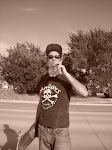
 This out in front of Kasey's parents home in Coronado. This must be when we were in college, since that's my Guild guitar in my hand.
 At the Kolassa's house in December. Tabby, Spencer, me, and Kasey.
 Jamming in the basement at Kasey's house. I think I must be in seventh grade in photo, since that's my first guitar, a 1976 Fender Stratocaster. I bought it when they were cheap during the "hair metal" guitar god days, when flying V's and other Hessian guitars were popular in San Diego.
 _008.jpg) These photographs show a skate ditch that no longer exists, the Uncle Wiggly ditch in Sorrento Valley. During the late 1980s, developers in conjunction with the science complex at UCSD built up Sorrento Valley very quickly. Since all the infrastructure for San Diego's little Silicon Valley needed to go in first, there were quite a few really good skate spots on San Diego's suburban fringe. This place was fairly isolated in one of the canyons near I-5. It was a cool place to hang out there since no one else was around.
These photographs show a skate ditch that no longer exists, the Uncle Wiggly ditch in Sorrento Valley. During the late 1980s, developers in conjunction with the science complex at UCSD built up Sorrento Valley very quickly. Since all the infrastructure for San Diego's little Silicon Valley needed to go in first, there were quite a few really good skate spots on San Diego's suburban fringe. This place was fairly isolated in one of the canyons near I-5. It was a cool place to hang out there since no one else was around. _007.jpg) Kasey Kolassa, Smith grind at Uncle Wiggly ditch.
Kasey Kolassa, Smith grind at Uncle Wiggly ditch._006.jpg) Sweeper at the Uncle Wiggly ditch. I had long hair back.
Sweeper at the Uncle Wiggly ditch. I had long hair back._004.jpg) Smith grind. I think that thing on my arm must be there because my arm was bleeding. It was easy to slam at this ditch.
Smith grind. I think that thing on my arm must be there because my arm was bleeding. It was easy to slam at this ditch._003.jpg) This is big Johnny Reichert and probably Ian Ragovin, Scott Ratigan's little brother. We used to bring him skating all the time, and I think he liked hanging out with the big guys. John Reichert was the gnarliest punk rocker I ever knew, and he had the best record collection. He had every U.K. Subs and The Damned albums. For a big guy, 6'4" and 230 +, he was an aggressive skater. John lives up in Seal Beach I think and is an art teacher.
This is big Johnny Reichert and probably Ian Ragovin, Scott Ratigan's little brother. We used to bring him skating all the time, and I think he liked hanging out with the big guys. John Reichert was the gnarliest punk rocker I ever knew, and he had the best record collection. He had every U.K. Subs and The Damned albums. For a big guy, 6'4" and 230 +, he was an aggressive skater. John lives up in Seal Beach I think and is an art teacher._002.jpg) Boneless at the Uncle Wiggly ditch. Once the cops busted us for tresspassing on this property. It was funny, because there was nothing there. But this was the San Diego suburbs during the Reagan Era, so you can only imagine what the cops thought of our antisocial clothes and activities like skateboarding.
Boneless at the Uncle Wiggly ditch. Once the cops busted us for tresspassing on this property. It was funny, because there was nothing there. But this was the San Diego suburbs during the Reagan Era, so you can only imagine what the cops thought of our antisocial clothes and activities like skateboarding. _005.jpg) Smith grind. This is either Charles Mehling or Kasey Kolassa. I'm thinking Kasey because of the shoes.
Smith grind. This is either Charles Mehling or Kasey Kolassa. I'm thinking Kasey because of the shoes. This is Hiawatha Bowen doing a frontside boneless at the quarter pipe at John Reichert's house. We would just put it in the street and hit it with loads of speed. As he got older, Hiawatha really became a great skater, one of the most gifted skaters I've ever seen. He is somehow related to the legendary Quanah Parker.
 This is the halfpipe at John Reichert's house in the side yard. This is Creighton Lasky on the ramp, with Mike Garcia, Charles Mehling, and Garrett Scott on deck. Below is my cousin, cowboy Jay Miller and Hiawatha Bowen. John's mom was super cool and just let us build it in the side yard. It was made from "liberated" lumber.
The ramp was super gnarly, 10 feet high with a foot-and-a-half of vertical. I learned to drop in on this ramp and it was a pretty scary beast. Since the chimney was about 12 inches from the side of the ramp, if you wiped out on the house side, you could bet wedged between it and the ramp. I remember seeing Eric Kerley get stuck in there.
 Charles Mehling, backside air on the quarter pipe. Chuck was a very good skater that really taught us alot of stuff about skateboarding, since I think he had lived in Upland where that gnarly Upland skate park was. He was kind of the ringleader and he never had any qualms about getting into trouble with the law, for example, when we would drive around looking for empty pools to skate in Gary Gadsen's green VW van after school.

Rock and Roll, the Reichert quarter pipe. Check the Minor Threat t-shirt.
 Garrett Scott, backside air at the Reichert pipe. When my family saw Kasey in Santa Cruz, we had alot of cool stories to tell about Garrett. I'll likely share some of those when I do a post on him solely.
 Kasey Kolassa, smith grind at Derby Park, probably Spring 1988.
 Me on the hip at Derby Park.
 This might either be me or this guy named Lars we knew.
 Tim Rush, backside grind at Derby Park. Tim had these super wide Independent trucks, so when he grinded on the snake run, it really caught your attention. The edges were not backfilled, so you could grind it anywhere. When we went back last month, it had been finished off to the edge with concrete. How un-punk rock!
 Smith grind, Derby Park. I'm wearing my grandfather Bill's French beret. I also liked it because Skeeter Thompson from Scream had one, too. By the way, speaking of Scream, Dischord recently re-issued the classic Still Screaming album, and it's been remastered. It was the first great sounding Dischord album in terms of production, so check it out.
 This is Chuck, one of our skating pals, super gnarly frontside air off the hip at Derby. Chuck was a very good skater and a graduate student in architecture and urbanism at UCSC. Once he gave a tour of downtown Santa Cruz to some visiting architects from Europe. They couldn't figure out the metal strips on curbs and ledges around town, and Chuck had to explain to them that they were to deter skateboarders from grinding the ledges.
 Me doing a frontside air off the hip at Derby Park. I had some green suede Vision hightops.
 Charles Mehling, backside air on the quarter pipe. Chuck was a very good skater that really taught us alot of stuff about skateboarding, since I think he had lived in Upland where that gnarly Upland skate park was. He was kind of the ringleader and he never had any qualms about getting into trouble with the law, for example, when we would drive around looking for empty pools to skate in Gary Gadsen's green VW van after school.
Rock and Roll, the Reichert quarter pipe. Check the Minor Threat t-shirt.
 Garrett Scott, backside air at the Reichert pipe. When my family saw Kasey in Santa Cruz, we had alot of cool stories to tell about Garrett. I'll likely share some of those when I do a post on him solely.
 Kasey Kolassa, smith grind at Derby Park, probably Spring 1988.
 Me on the hip at Derby Park.
 This might either be me or this guy named Lars we knew.
 Tim Rush, backside grind at Derby Park. Tim had these super wide Independent trucks, so when he grinded on the snake run, it really caught your attention. The edges were not backfilled, so you could grind it anywhere. When we went back last month, it had been finished off to the edge with concrete. How un-punk rock!
 Smith grind, Derby Park. I'm wearing my grandfather Bill's French beret. I also liked it because Skeeter Thompson from Scream had one, too. By the way, speaking of Scream, Dischord recently re-issued the classic Still Screaming album, and it's been remastered. It was the first great sounding Dischord album in terms of production, so check it out.
  This is Chuck, one of our skating pals, super gnarly frontside air off the hip at Derby. Chuck was a very good skater and a graduate student in architecture and urbanism at UCSC. Once he gave a tour of downtown Santa Cruz to some visiting architects from Europe. They couldn't figure out the metal strips on curbs and ledges around town, and Chuck had to explain to them that they were to deter skateboarders from grinding the ledges.
 Me doing a frontside air off the hip at Derby Park. I had some green suede Vision hightops.